
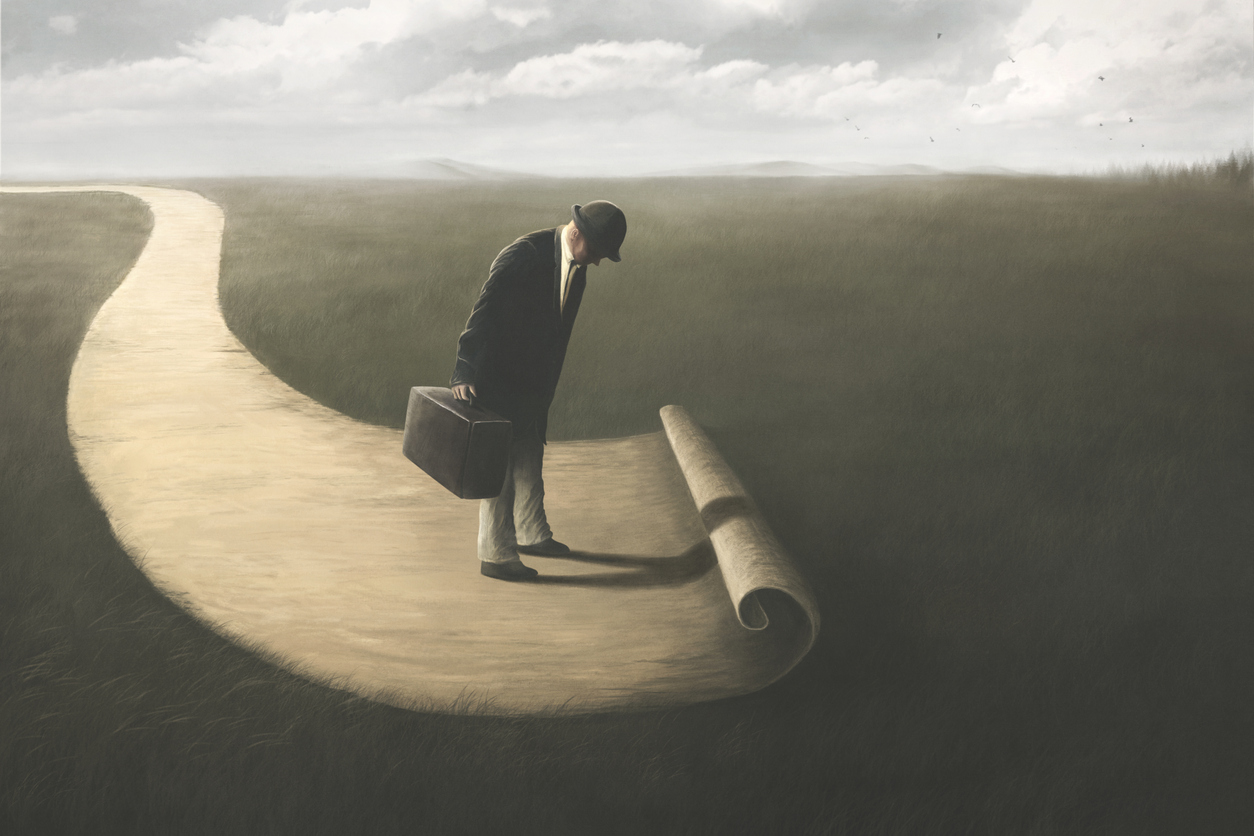
The other day I said to myself, “I need to set my own course and steer my own ship.”
What?
I never think of my life as a sea journey. Not at all. But that metaphor of navigating rough seas, bounding through crests and troughs, weathering the lashing winds to reach my destination, just spurted out.
Another metaphor I use to describe my life is the long hike.
Picture Cheryl Strayed’s journey along the Pacific Crest Trail in her memoir, Wild.
Or people pilgrimaging along the Camino de Santiago, or the Appalachian Trail.
But do I actually see my life as a series of uphills and downhills, peaks and valleys? Is my life just a matter of putting one foot in front of the other?
Most of the time, no.
But how many times have I coached myself (and my yoga students) with that tired line that “the journey of a hundred miles begins with one single step?”
Hundreds.
These metaphors are so ubiquitous that they just trip off the tongue. We say this stuff without ever considering if it fits how we feel.
Everyone is now on some kind of a journey: a weight-loss journey, a healing journey, a sobriety journey, a trauma-healing journey, and even (raises hand here) a sourdough journey.
If this journey metaphor works for you, great, but what if it doesn’t, and you’re just mouthing cultural cliches? Maybe we need to think about how we actually see our lives, and align our metaphors to fit better.
I don’t see my life as a journey.
I’ve considered switching to “Odyssey,” but that doesn’t work either.
Yeah, sometimes I see myself caught between Scylla and Charybdis, or needing to put wax in my ears to resist the siren song of some bad-for-me thing I can’t resist, but most of the time, no. My life isn’t an odyssey either.
When I see myself moving through life, moving through time, I see the calendar, I see seasons. I am a writer. I am a yoga teacher. I see my life as a set of seasonal projects on a long-running calendar.
The calendar is the spine of my life: years, quarters, months. Seasons, in the Ayurvedic sense, provide elemental themes for each period. Within each season, I run a small number of projects that fit the season’s mood and my own.
For example, this spring (the Kapha season in Ayurveda), I focused on spring cleaning and decluttering.
In my teaching, I built gentle strengthening sequences to prepare my students for the upcoming summer sports and gardening season.
In my reading, I switched to easy-to-read popular novels (Margo’s Got Money Problems, Yesteryear).
My life isn’t moving down a path; it’s tending projects that belong to this season, in this body, in this place.

Instead of a journey, I now want to get into the habit of saying, “This season’s project in my life is…” or “I’m in a pitta-tinged phase of my work, so my current project is…”
This new metaphor allows endings to become completions rather than failures. I can pause or archive a project at season’s end without implying that I abandoned my path.
Rest is baked in. A fallow or integration season isn’t a detour from the journey, but allows it to emerge.
I can run multiple projects at the same time, like a small writing project and a small teaching experiment, without feeling that everything must serve one overarching epic.
Having a consciously chosen metaphor (or cluster of them) helps you see your patterns. Someone whose life metaphor is a garden, will evaluate decisions in terms of what they’re tending, pruning, or allowing to go to seed, which is more meaningful than, “I guess I’m on some vague journey.”
I think the point isn’t to find the perfect metaphor for your life, but rather to reclaim authorship over the language that shapes your sense of duration and purpose.
Some days, “hike” or “odyssey” are useful metaphors; a specific transition is a mountain pass; and that one phone call was a battle. But having a consciously chosen metaphor for your life is important because metaphors steer your moods, set your priorities, and clarify your identity.


